How to Choose the Right Aircond Size (HP) for Your Room
Don't overpay for an oversized unit or suffer with one too small. Calculate the perfect aircond HP for your room size.
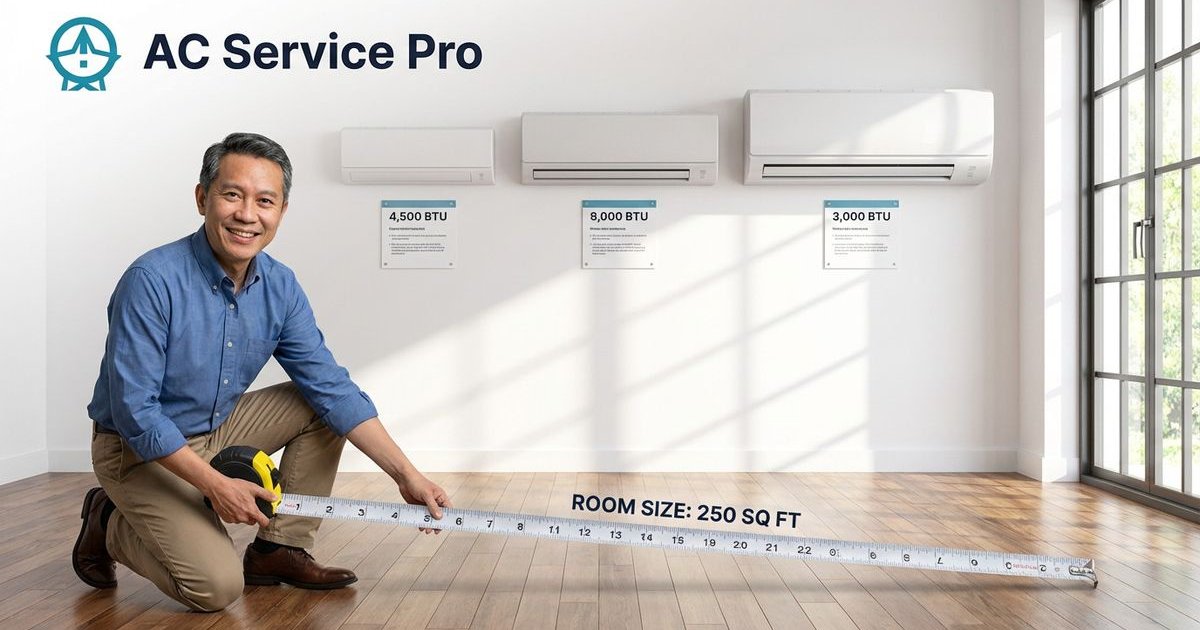
How to Choose the Right Aircond Size (HP) for Your Room
Selecting an air conditioner involves much more than picking the most affordable model or the flashiest brand. Getting the right size for your specific room is the single most important decision you will make.
Across hundreds of site visits in Kepong, from terrace houses in Taman Kepong to condos near Desa ParkCity, our technicians have seen the same problem repeated over and over: homeowners install a “powerful” unit only to find the room feels cold yet uncomfortably damp. This happens because of what HVAC engineers call the Short-Cycle Threshold.
When you cross this threshold by purchasing a unit that is too large, the compressor cools the air so rapidly that it shuts off before it has a chance to pull moisture from the room. The result is a sticky, clammy atmosphere paired with a higher TNB bill. Ironically, a slightly undersized unit often delivers better comfort than a massively oversized one.
Here is a practical breakdown of the data, what your room actually requires, and how to calculate the ideal horsepower (HP) to keep your home dry, cool, and energy efficient.
Quick Size Guide for Malaysian Homes
For most standard condominiums and terrace houses with 9-10 foot ceilings, this baseline guide is a reliable starting point.
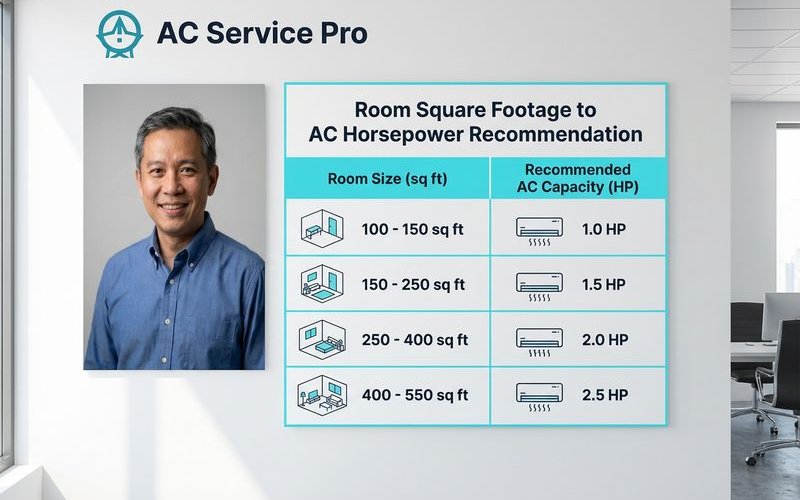
| Room Size (sq ft) | Typical Room Type | Recommended HP |
|---|---|---|
| Up to 120 | Small Bedroom / Study | 1.0 HP |
| 120 - 180 | Master Bedroom | 1.5 HP |
| 180 - 250 | Large Master / Small Living | 2.0 HP |
| 250 - 350 | Standard Living Hall | 2.5 HP |
| 350 - 450 | Open Concept Living/Dining | 3.0 HP |
This table assumes a standard concrete room. Read on for the specific variables that might bump you up a size.
How to Calculate Your Room Size
Step 1: Measure the length and width of your room in feet.
Step 2: Multiply: Length x Width = Square feet.
Step 3: Subtract major built-ins.
Many homeowners in Kepong make the mistake of including floor-to-ceiling wardrobes in their total square footage. These areas do not require cooling, so deducting that 20-30 sq ft can sometimes prevent you from purchasing an oversized unit.
Example Calculation:
- Standard Bedroom: 12 feet x 10 feet = 120 sq ft → 1.0 HP
- Master Bedroom: 15 feet x 12 feet = 180 sq ft → 1.5 HP
- Living Room: 20 feet x 15 feet = 300 sq ft → 2.5 HP
Factors That Increase Cooling Needs
Your room might technically match the “Standard Guide,” but real-world conditions in Malaysia’s tropical climate can push the demand higher.
1. High Ceilings (Lofts & Bungalows)
- The Fact: Standard cooling calculations assume a 9-10 ft ceiling. Many older bungalows in Kepong or modern loft-style apartments have ceilings reaching 12 feet or higher.
- The Adjustment: For every foot over 10 feet, the total volume of air increases considerably. Add 0.5 HP to your calculation to compensate for the extra cubic footage.
2. Intense Sun Exposure (The “West Sun” Factor)
- The Fact: A room with west-facing windows absorbs direct, punishing afternoon heat, raising the ambient temperature by 2°C to 5°C compared to a shaded room.
- The Adjustment: If your room faces the sunset, add 20% to your required capacity. A 1.0 HP room becomes a 1.5 HP room.
3. Top Floor / Under Roof
- The Fact: Roof tiles, especially older clay or ceramic ones, radiate absorbed heat into the rooms below long after sunset.
- The Adjustment: This “heat soak” effect is persistent. Consider moving up one full size (e.g., 1.5 HP to 2.0 HP) for top-floor bedrooms to ensure proper sleep comfort.
4. High Occupancy
- The Fact: The average human body radiates approximately 400-600 BTU/hour of heat.
- The Adjustment: If you are cooling a home office with 3 people or a living room that hosts frequent gatherings, add 600 BTU (approx. 0.05 HP) per person beyond the first two occupants.
5. Heat-Generating Electronics
- The Fact: This remains the most overlooked factor in modern homes. A high-end gaming PC can output 1,000 to 3,000 BTU/hour while running, equivalent to having 5 extra people in the room.
- The Adjustment: For server rooms or dedicated gaming setups, you must increase your capacity by at least 0.5 HP.
Factors That Decrease Cooling Needs
You might save money by choosing a smaller unit if your room benefits from certain advantages.
1. Heavy Shading
- The Fact: North-facing rooms or those shaded by mature trees or neighboring condominiums receive minimal direct solar gain.
- The Adjustment: You can safely choose the lower end of the sizing spectrum (e.g., a 1.0 HP for a 130 sq ft room).
2. Ground Floor Insulation
- The Fact: Ground floors are naturally cooler because they do not contend with rising heat or roof radiation.
- The Adjustment: Standard sizing is almost always adequate here.
3. Modern Insulation Upgrades
- The Fact: Double-glazed windows or heavy blackout curtains can block up to 30-50% of incoming heat.
- The Adjustment: If you have invested in quality window tinting or insulation, you rarely need to go larger than the standard recommendation.
Common Sizing Mistakes
Mistake #1: Thinking “Bigger Is Better”
The Reality: An air conditioner has two jobs: cooling the air and removing moisture.
- The Consequence: A huge AC in a small room cools the air to 24°C in 5 minutes, then turns off. However, it takes 15-20 minutes of continuous running to effectively remove humidity.
- The Result: Your room reaches the target temperature but humidity stays at 70-80%, encouraging mold growth, musty smells, and that uncomfortable “sticky” feeling.
Mistake #2: The “Standard Bulk Buy”
The Reality: Developers frequently install 1.0 HP units in every bedroom regardless of size or sun orientation.
- The Consequence: The master bedroom facing West will never cool sufficiently, while the compact guest room feels like a freezer.
- The Fix: Customize each unit. At CoolBreeze Aircond Services, we always recommend sizing the living hall and master bedroom independently from guest rooms.
BTU vs HP: Understanding the Specs
Horsepower (HP) is actually a legacy term. The true measure of cooling power is BTU (British Thermal Units).
| HP (Approx) | BTU/hour Range | Best For |
|---|---|---|
| 1.0 HP | 9,000 - 9,600 | Small Bedrooms |
| 1.5 HP | 12,000 - 13,000 | Master Bedrooms |
| 2.0 HP | 18,000 - 19,000 | Living / Dining |
| 2.5 HP | 22,000 - 24,000 | Large Open Areas |
Pro Tip: Always check the BTU rating on the spec sheet. A premium 1.0 HP unit might deliver 9,600 BTU, while a budget model only offers 8,500 BTU. That 1,100 BTU difference is noticeable on a hot afternoon.
Inverter vs Non-Inverter Sizing
Non-Inverter (Fixed Speed)
- Behavior: Runs at 100% power until the target temp is reached, then shuts off entirely.
- Sizing Strategy: You must be accurate. Oversizing leads to severe short-cycling and electricity waste.
Inverter Technology
- Behavior: Can adjust its motor speed between 10% and 100% like a car accelerator.
- Sizing Strategy: These units are considerably more forgiving.
- Our Recommendation: If your calculation falls between sizes (e.g., you need 1.3 HP), buy the 1.5 HP Inverter. It will simply operate at 80% capacity most of the time, which is actually its most efficient “sweet spot,” saving you up to 30-50% on electricity bills compared to a strained smaller unit.
Multi-Split Considerations
If you are using one outdoor compressor for multiple indoor units, you rely on the Diversity Factor.
- The Concept: It is rare that every single room in your house needs 100% cooling power simultaneously.
- The Strategy: You can often install a slightly smaller outdoor unit (e.g., a 3.0 HP outdoor unit running three 1.0 HP indoor units + one 1.5 HP unit) because the system shifts power to where demand is greatest.
- The Warning: This requires professional calculation. If everyone turns on their AC at night, an undersized outdoor unit will fail to cool anyone effectively.
When to Ask a Professional
While online calculators offer a good starting point, certain layouts require an expert assessment.
- L-Shaped Rooms: Airflow does not turn corners effectively. You might need two smaller units instead of one larger one.
- Open Kitchens: Heat from cooking creates a massive load spike that standard sizing charts do not account for.
- Glass Walls: Floor-to-ceiling glass in modern condos functions like a greenhouse.
CoolBreeze Aircond Services Installation Service
We approach every aircond installation as an engineering challenge, not merely a mounting job.
- Site Assessment: We inspect insulation, sun orientation, and heat sources before recommending a size.
- Honest Sizing: We will talk you out of a more expensive, oversized unit if it will compromise your air quality.
- Future-Proofing: Our team considers your future plans, whether you are adding a gaming setup or partitioning a room.
Already have a unit? We can optimize its performance through proper placement and maintenance, even if the sizing is not ideal.
Need Help Choosing?
Not sure whether that West-facing window pushes you up to a 2.0 HP?
WhatsApp us your room photos and dimensions. We will provide a specific recommendation based on our experience across hundreds of Kepong homes, with no obligation attached.
Better yet, book a free site inspection. Let us measure the heat load properly so you do not spend the next 5 years fighting humidity in your own bedroom.
Need Aircond Service?
10+ years experience. 5,200+ customers served. Free gas top-up with chemical wash.
WhatsApp Us Now